Sunday, February 28, 2016

History Amongst the Tombs: Forest Home Cemetery


You may not know this about me: I love taking photos at cemeteries.  I still get creeped out walking on top of someone who is buried six feet under.  However, the sculptures dedicated to the departed are some of the best art you can find for free.  Today, since it was an unusual 60 degrees in Milwaukee for a February, I went down to Forest Home Cemetery, a place I've wanted to photograph for a long time.  This cemetery, the largest in Wisconsin and home to many prominent residents, is located south of I-94 near a vastly Latino community, but has been around since 1850. 

The claim-to-fame of Forest Home Cemetery is that a lot of Milwaukee's founders are buried there.  More specifically, our beer barons.  Pabst, Schlitz and Blatz, the names that built Milwaukee into what it is today, have grave markers or mausoleums on the grounds.

The Blatz Mausoleum


The Schlitz grave marker

The Pabst family grave marker

In addition to the beer barons, many other famous names have made the cemetery their final resting place.  Names such as Arthur Davidson (Harley-Davidson):


Guido and Charles Pfitster (owners of the Pfister Hotel):


Frederick Vogel, a tanner and State Assemblyman.  Vogel Hall in the Milwaukee Repertory Theatre is named after him:


Fredrick Usinger, creator of the best sausage/bratwurst in America:


Charles Allis, founder of Allis-Chalmers and whom the city of West Allis is named for:


And Alfred Lunt & Lynn Fontanne, a very famous theatre couple who resided in Genesee, Wisconsin.  I have visited Ten Chimneys, their primary residence, which reminded me a lot of Graceland.  I will do a blog post on my visit later this year, when tours are available, around May.


Besides the famous grave stones, there are a lot of interesting markers that are artistic in nature.  I think it's great that the departed (or their relatives) have endowed these amazing sculptures as their markers.  More common is the obelisk, a marker that goes back to the ancient Egyptians and symbolizes the sun God Ra.  I know they became popular after Napoleon's invasion of Egypt in the 1700's, but why have they sustained such popularity prior to the Civil War and afterward?  If anyone knows the reason, feel free to post in the comments.


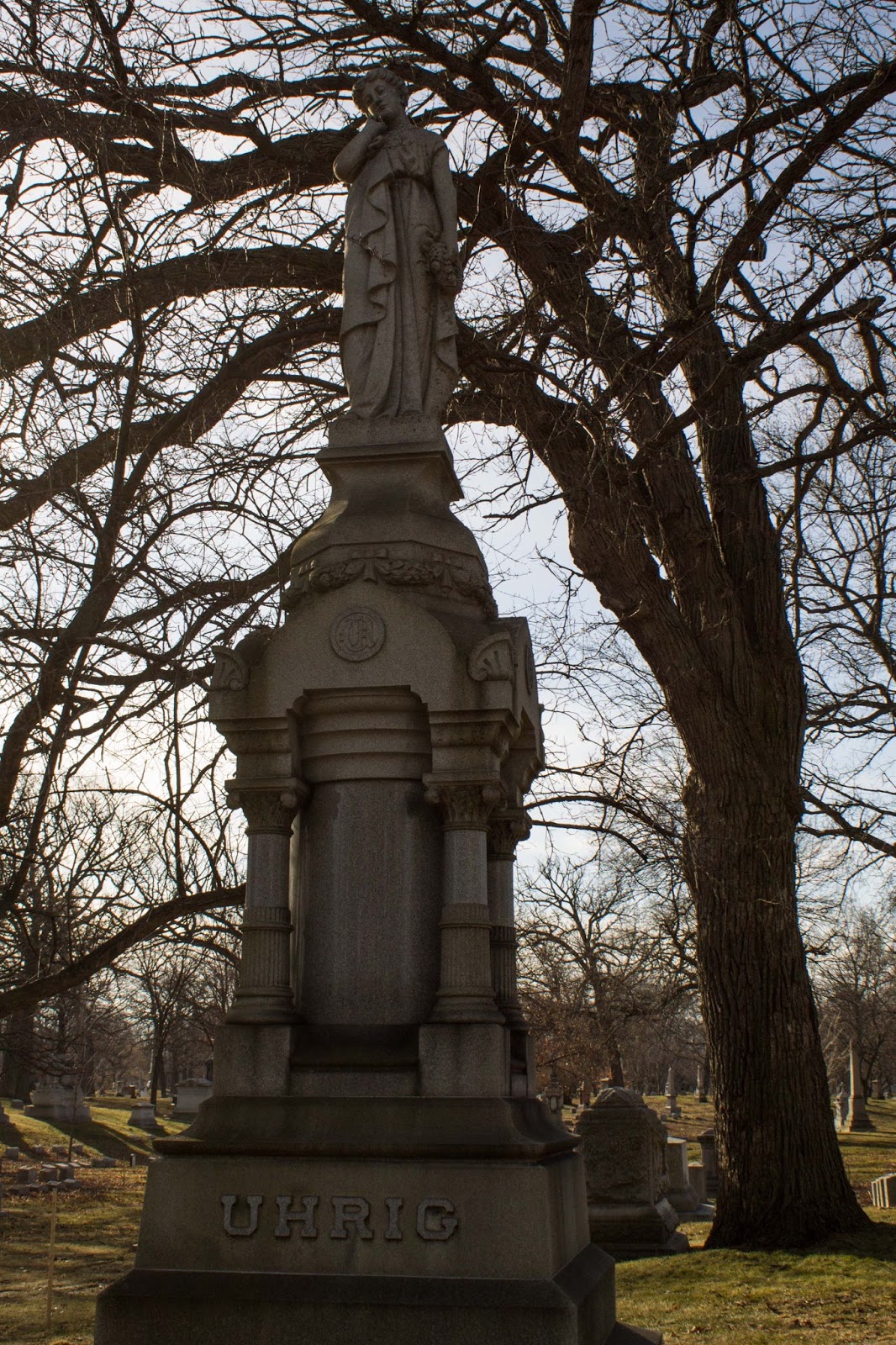
In addition to the famous residents and the obelisk markers, many of the departed had sculptures created for their final resting place.  I find those the most interesting.  I have never been to the Pere Lachaise cemetery in Paris, but it is a dream of mine (and not just to see Jim Morrison's final resting place).  This cemetery had a lot of interesting sculptures to celebrate the lives of their departed family members.




Last, but not least, there is the grave marker of Henry Clay Payne, Postmaster General from 1902 to 1904 when Theodore Roosevelt was president.  From the very nice words on his grave marker, he was not only a statesman but a "kindly neighbor", a "loyal friend" and a "benefactor of the deserving."  Basically, an all-around good guy.


For more information on the Forest Home Cemetery, click here.


Saturday, February 6, 2016

Snow Time: National Snow Sculpting Competition


Did you know that Lake Geneva, Wisconsin is the home of the United States National Snow Sculpting Competition?  Not only that, but that they have hosted this event for the last 21 years?  I didn't until I found out about it this morning on Twitter.  Since the temperature this February has been above normal, I headed down to Lake Geneva to get photos of the competition before a thaw set in.  In fact, when I was down on the lakefront, I saw that they allowed cars to park on the frozen lake due to the popularity of the event and lack of parking downtown.  Hours later, as I was working on my photos, the sun came out, the lake got warmer, and many cars that were parked on the lake plunged into the water due to the melted ice. 


But, the competition itself was a fun event. When I got down to the lakefront, I felt like it was Groundhog Day.  Not the holiday, the movie (one of my all time favorites).  They even played "The Pennsylvania Polka" while I was there, which reinforced the film's similarity.  I half-expected someone to come up to me asking "Here to see the snow sculptures?"

The sculptures themselves were amazing!  I am still in awe of what the competitors came up with for their sculptures.  I will let the photos speak for themselves.


The snow sculptures will be on display this week as long as the temperature keeps them from melting.  I'm thinking 3 to 4 days tops.

Wednesday, February 3, 2016

Monster Invasion: Mitchell Park Domes Garden Railroad Show


Every year, Milwaukee's Mitchell Park Domes presents its garden railroad show, and each has a specific theme.  This year's theme is "Monsters" as in movie monsters. 


The main set is always the same with bridges, a desert area, a monorail, and a colorful residential area.  But this year, they added a cityscape (where a giant gorilla hung from a skyscraper), a drive-in theatre (where, strangely, Elsa from "Frozen" was on an adventure with the pair from "Monters, Inc.") and fake movie posters featuring the monsters, as well as Thomas the Tank, around the perimeter.


I loved both the cityscape with its Town Square and soldiers on the rooftop.  I also enjoyed the colorful town.


There's still plenty of time to visit this year's garden railroad show.  The Mitchell Park Domes is open seven days a week and the show runs until March 6.

**Update: The Mitchell Park Domes is closed indefinitely due to "falling concrete".  I never experienced this problem, but it is serious enough for the county to close one of its most famous tourist attractions until further notice.  Such a shame, but I hope they can fix the problem quickly and safely.


Sunday, January 3, 2016

City of History: Kenosha, Wisconsin


Yesterday, despite the fact that we've officially entered winter and the coldest part of the year, I ventured an hour south of Milwaukee to the lakefront city of Kenosha.  Kenosha is best known for its production of automobiles for Nash, Rambler, Hudson and AMC between 1902 and 1988, and has remained a city rooted to its past.  It even has historic, fully-operational streetcars that run throughout the city.

I have only been to Kenosha a few times, most memorably to visit the Bristol Renaissance Fair a few summers ago, but had never been to the downtown area.  I knew they had a lot of interesting museums, and I took the time to visit two of them, the Public Museum and the Civil War Museum.  But first I had to see the lakefront.


I knew from seeing other photos online and video on TV, that Kenosha has a very nice red lighthouse that jets out into Lake Michigan.  And I knew I wanted to add to my photographic collection of lighthouses with this one.  What I didn't know was that this part of the lakefront has 3 lighthouses including matching red and green striped ones, the green one close to its rocky coast and the red one further out into the lake.  I tried to get a good photo of pairs of these lighthouses, and a couple of them turned out better than I expected.  I had used my telephoto lens when I was in Port Washington because the lighthouse there was so far away from land, but since the red lighthouse was so close, I was able to use my wide-angle lens (and my polarizing filter) to get the lighthouse pairs.


The lakefront also has some cute sculptures in its Harborpark.  My favorite was this pig with a tuba:


After getting as many photos as I could at the lakefront before the sun rose too high, I headed over to the Public Museum and the Civil War Museum which, conveniently, sit side-by-side down the street. 


The Public Museum was small, but free (donations encouraged), and their main exhibit was a history of the Kenosha area which went back all the way to before the ice age, and included indigenous animals, the life of Native Americans in the area, and the bones of a mammoth that was discovered there.  They also have a second floor of rotating exhibits. 


The Civil War museum (which costs $9 in admission) was fascinating.  Every hour on the hour, they have a 15-minute 360 degree film where they show the lives of Union soldiers which feature professional reenactors and was filmed at Old World Wisconsin.  They also present a complete history of the war with makeshift buildings including stocked general stores, a train depot, and boarding houses, each with newspaper clippings of the war plastered to their walls, so you get a year-by-year account.  Like the Public Museum, they also have a second floor of rotating exhibits.


There was one more museum I wanted to visit, but I ran out of energy.  That was the Dinosaur Museum.  That will be something for another day in Kenosha. 


Friday, January 1, 2016

New Year's Resolution: I am a Photojournalist

Milwaukee River

I am not an artist.  Despite the fact that photography is considered an art form, and is my passion, I need to stop striving to consider my work as art.  My work would be considered photojournalism, and I have finally come to terms with that fact. 

You might think, that's obvious.  This is a blog after all, the hobbyist version of a news publication.  And it's a blog about tourist spots around my part of Wisconsin.  Automatically that makes it photojournalism.  But, and I think you might agree with me, all photographers want their work to be elevated to art, despite the fact that art is subjective.  In 2015, I struggled with the fact that I didn't think my photography would never be featured in a gallery or sold at the Lakefront Festival of the Arts.  I struggled with the fact that my photographs were simply "snapshots".


The word "snapshot" has become a bit of a dirty word in photography.  It has come to mean a photo that anyone with a cell phone can take, even though the software on some of these phones can turn any photo taken into art.  But, what makes a picture taken with your fancy camera (or your phone) into a "photograph"?  According to David Peterson, who wrote on Digital Photo Secrets, photography "should have some quality that makes the viewer either feel an emotion or think about a concept."  And I think that's the best way to put it.  A photograph, as art, should be something not normally seen (like with street photography) and/or makes you go "Wow!" (like a great landscape). 

Community United Methodist Church, Elm Grove, Wisconsin

Great photojournalism can do this as well.  In fact, the greatest influence in my photography has been old issues of Life magazine.  When I was in middle school, my mother bought a copy of Life's 50th anniversary edition, over a thousand pages of photographs from the magazine's history that featured the greats such as Margaret Bourke-White, Gordon Parks and Robert Capa among others.  I poured over those photographs for hours, over and over again.  But, everyday photojournalism informs more often than it inspires.  In fact, photojournalism is supposed to be just a snapshot.  Photographers who work for the Associated Press cannot manipulate or stage their photos for ethical reasons, a topic that made news last year.

I'm happy to consider myself a photojournalist.  I like informing people, through my photos, of great places, fun events, and the beautiful areas I get to visit week after week.  Are they snapshots?  A resounding "Yes!"  My goal is to see my work in magazines, both online and in print, not hung on a wall.  That makes me a photojournalist.  My resolution for 2016 is to embrace this label and stop worrying if I will ever be an artist. 

Old World Wisconsin